What Happens If You Can't Repay a Loan App in India?
 James D
Last Updated: July 2026 | By James D — Mumbai-based borrower, not a financial advisor
That's what almost every person in this situation says — and it's almost always true. Missing an EMI on a loan app is rarely an act of deliberate fraud. It's usually a salary delay, an unexpected expense, a client who didn't pay on time, or two financial pressures arriving in the same week. The loan app doesn't know or care about any of that. What it does know is that today is Day 1 of a default, and what happens next follows a very specific and predictable sequence.
I missed a payment by 6 days once. What I experienced in those 6 days — and the 3 months of CIBIL consequences that followed — taught me more about how these apps actually operate than anything I'd read before applying. This article is the full picture of what happens, in order, when you can't repay a loan app in India.
Missing an EMI on a loan app triggers late fees immediately, recovery calls within 24–48 hours, and CIBIL reporting after 30–90 days depending on the lender. You cannot be arrested for a missed EMI — loan default is a civil matter in India, not a criminal one. Any app that threatens arrest or FIR is using an illegal scare tactic. What you can do matters more than what's happening to you — contact the lender before the situation escalates, not after.
What Happens Day by Day After You Miss an EMI
The sequence is more predictable than most borrowers realise. Here is what actually happens, in order:
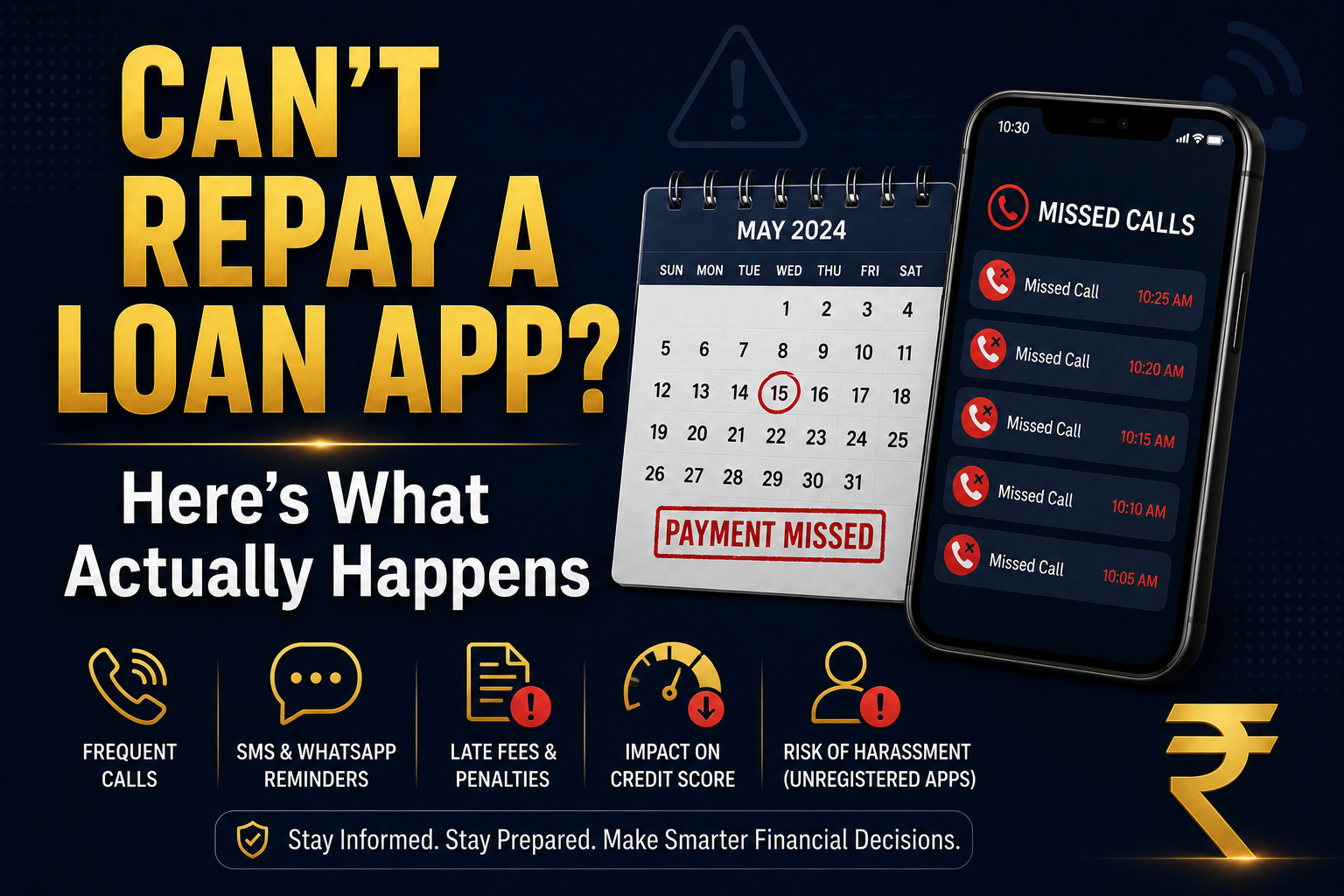
The moment midnight passes on your due date, late fees are applied automatically. Typically ₹200–₹600 flat fee plus 1–3% penal interest per day on the outstanding amount. On a ₹10,000 loan, you're looking at ₹300–₹900 added in the first 24 hours alone. The auto-debit attempt may also trigger a bank bounce charge of ₹300–₹500.
Automated reminders via SMS, email, and in-app notification. Multiple per day. At this stage these are system-generated, not human-initiated. If you can repay now, do it — the situation is still contained.
Human recovery agents now contact you by phone — sometimes multiple calls per day from different numbers. RBI guidelines permit calls only between 8am and 7pm. Calls outside these hours, abusive language, or threatening messages are illegal regardless of how overdue your payment is. Document anything that crosses that line.
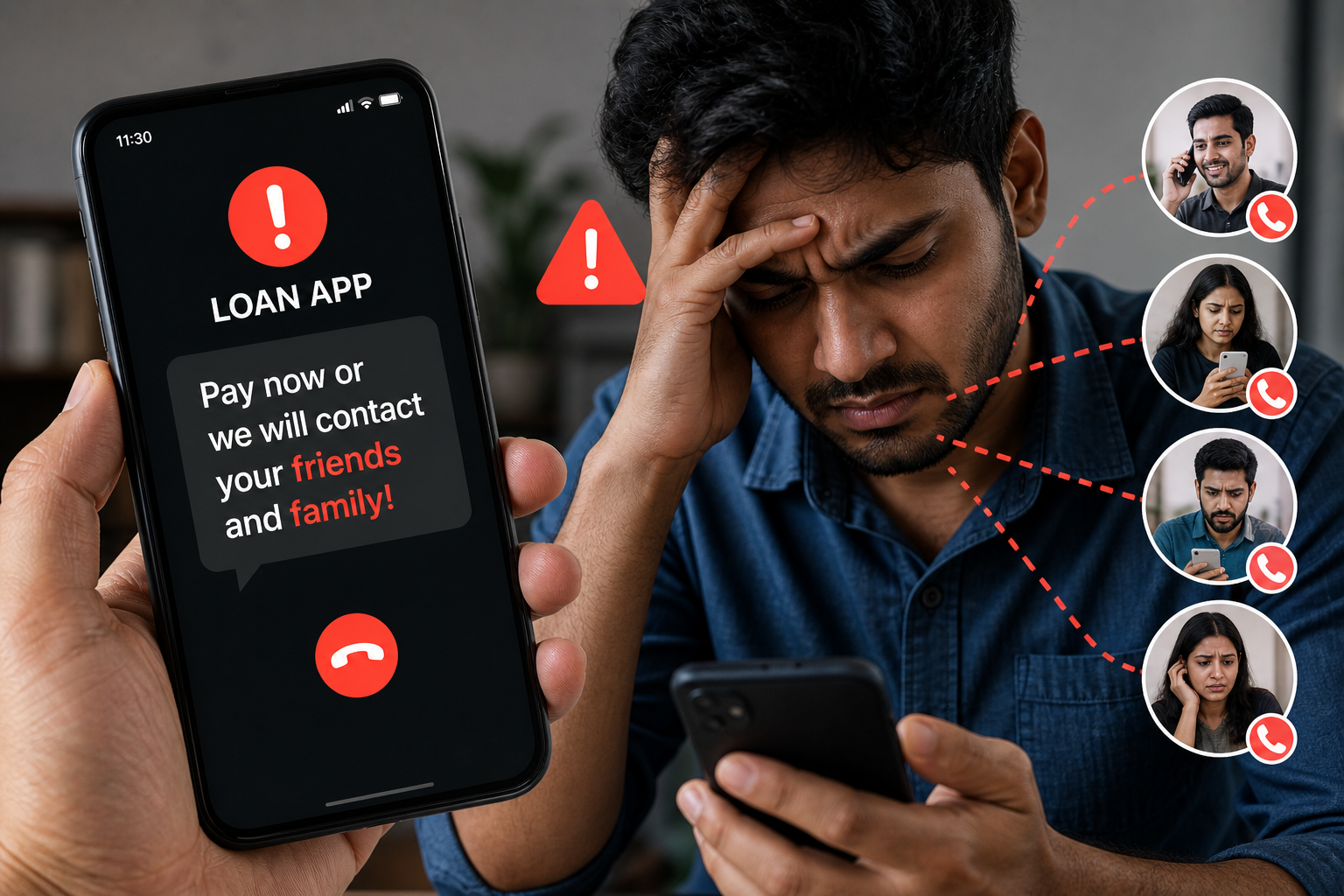
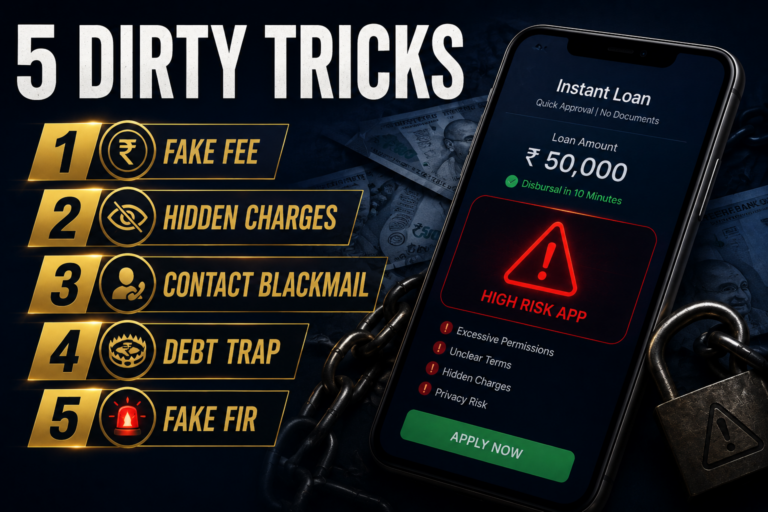
Some apps attempt to contact emergency contacts listed during onboarding, or — for unregistered apps — attempt to message contacts accessed from your phone during installation. Contacting your friends, family, or employer to shame or pressure you into repaying is illegal under RBI's 2022 digital lending guidelines. Screenshot any such messages immediately.
RBI-registered apps report missed payments to credit bureaus (CIBIL, Experian, CRIF) after 30–90 days of default, depending on their reporting cycle. Once this entry appears on your file, it suppresses your score immediately and stays visible to all lenders for years. This is the most significant long-term consequence of a missed payment — and it cannot be undone, only offset by subsequent positive entries.
After 90 days without payment, the loan is classified as a Non-Performing Asset (NPA). The lender may send a formal legal notice, initiate debt recovery proceedings under the SARFAESI Act (for secured loans), or pursue civil suit under the Recovery of Debts Act. For small personal loans from apps, civil suit is rare but possible. The debt does not disappear — it compounds.
What Happened to Me — 6 Days, 14 Calls
In 2023 I missed a ₹4,800 EMI by 6 days. It wasn't planned — a client payment I'd been expecting didn't come through until the following week, and I had to choose between rent and the loan repayment. I chose rent and assumed I'd sort the loan the moment the client payment landed.
In those 6 days I received 14 calls from 6 different numbers. Most were from recovery agents — some polite, some not. Two called after 8pm, which is a violation I documented but didn't act on at the time. One message was sent to a former colleague whose number was in my contact list, which I had granted the app access to during sign-up without reading the permissions carefully.
When the client payment arrived on Day 6, I paid the full amount including the accumulated late fees — which by then had added ₹1,100 to a ₹4,800 repayment. More than 20% of the original loan, gone in 6 days of delay.
Three weeks later I checked my CIBIL score. It had dropped from 711 to 663 — a 48-point fall. It took 5 months of consistent, on-time repayments on two other accounts to recover to 710. That's 5 months of financial discipline to reverse 6 days of unavoidable delay.

Your Legal Position — What They Can and Cannot Do
Most borrowers in this situation don't know their rights — and recovery agents count on that. Here is the legal reality:
| Action | Legal? |
|---|---|
| Calling you between 8am and 7pm | ✅ Legal |
| Sending repayment reminders via SMS/app | ✅ Legal |
| Adding late fees as disclosed in the loan agreement | ✅ Legal |
| Reporting to CIBIL after 30–90 days | ✅ Legal |
| Sending a formal legal notice after 90 days | ✅ Legal |
| Calling before 8am or after 7pm | ❌ Illegal — RBI violation |
| Using abusive or threatening language | ❌ Illegal — IPC violation |
| Contacting your friends, family, or employer | ❌ Illegal — RBI digital lending guidelines |
| Threatening arrest or FIR for loan default | ❌ Illegal — default is civil, not criminal |
| Sending fake legal notices or court summons | ❌ Illegal — criminal offence |
| Accessing your contact list without permission | ❌ Illegal — IT Act violation |
The CIBIL Impact — What a Missed EMI Actually Does to Your Score
This is the consequence most borrowers underestimate — and the one that lasts longest. A missed payment on a loan app creates a negative entry on your CIBIL report that is visible to every lender you approach for years afterwards. The specific impact depends on your starting score, the loan amount, and how long the default continues, but the general pattern is consistent:
| Default Duration | Typical Score Impact | Recovery Timeline |
|---|---|---|
| 1–7 days (paid quickly) | 10–30 point drop | 2–4 months |
| 8–30 days | 30–60 point drop | 4–8 months |
| 30–90 days | 60–100 point drop | 6–12 months |
| 90+ days (NPA) | 100–150 point drop | 12–24+ months |
My personal experience: a 6-day delay on ₹4,800 dropped my score from 711 to 663 — a 48-point fall that took 5 months of consistent repayment to reverse. The asymmetry is real and it's severe. Repaying on time adds points slowly. Missing a payment removes them immediately.
What to Do Right Now — Step by Step
Whether you've already missed a payment or can see one coming, the steps below are ordered by urgency. The earlier you act, the more options you have.
If you know you cannot make the repayment, call or email the app's official customer support before the due date. Ask specifically about a repayment extension, a restructured EMI schedule, or a partial payment arrangement. Most RBI-registered NBFCs have a formal hardship process — this conversation is uncomfortable but it is always better than a missed payment on your credit file. Go through official channels only: the support email or in-app chat, not the recovery agent who is calling you.
From the moment the recovery calls start, document everything. Screenshot threatening messages, note call times (especially anything before 8am or after 7pm), and save any communications sent to your contacts. This evidence is your protection if the recovery tactics cross legal lines — and it strengthens any complaint you file.
Go to Settings → Apps → [App Name] → Permissions → revoke contacts, gallery, microphone, and location access. This cuts off the app's ability to access further data from your phone. Revoking permissions does not cancel your debt — you still owe what you borrowed — but it stops further data harvesting and prevents contact list access for recovery purposes.
If you cannot repay the full amount, pay whatever you can — even a partial payment demonstrates good faith and often reduces the intensity of recovery activity. More importantly, contact the lender to confirm that the partial payment has been recorded and ask how the remaining balance is being handled. Get any agreement in writing via email, not just a phone call.
If recovery agents contact your friends or family, use abusive language, call outside permitted hours, or send threatening messages: file a complaint at cybercrime.gov.in (or call 1930) for harassment and data misuse, and at the RBI Sachet portal at sachet.rbi.org.in for violations of digital lending guidelines. Attach your screenshots. These complaints have resulted in enforcement action against multiple apps and their NBFC partners.
This is the most dangerous response to a missed payment — and the most common mistake. Borrowing from a second app to cover the first creates two repayment deadlines where there was one, doubles your fees and interest exposure, and almost inevitably leads to a third loan, then a fourth. If you are considering this, read Can You Take a Loan From Two Apps at the Same Time? before acting. The answer is almost always: find another way.

GetLoanCredit Verdict
Missing an EMI on a loan app is not the end — but it is the beginning of a sequence that escalates fast and costs more than most people anticipate. The fees compound daily. The recovery pressure intensifies. And the CIBIL damage lingers for months after you've repaid in full.
What separates borrowers who get through this from those who spiral is one thing: speed. The faster you contact the lender, the more options you have. The faster you repay, the lower the fees. The faster you document illegal recovery tactics, the stronger your complaint.
You cannot be arrested. The debt is real and must be repaid. But you have rights — and using them, quickly and calmly, is always better than panic.
Frequently Asked Questions