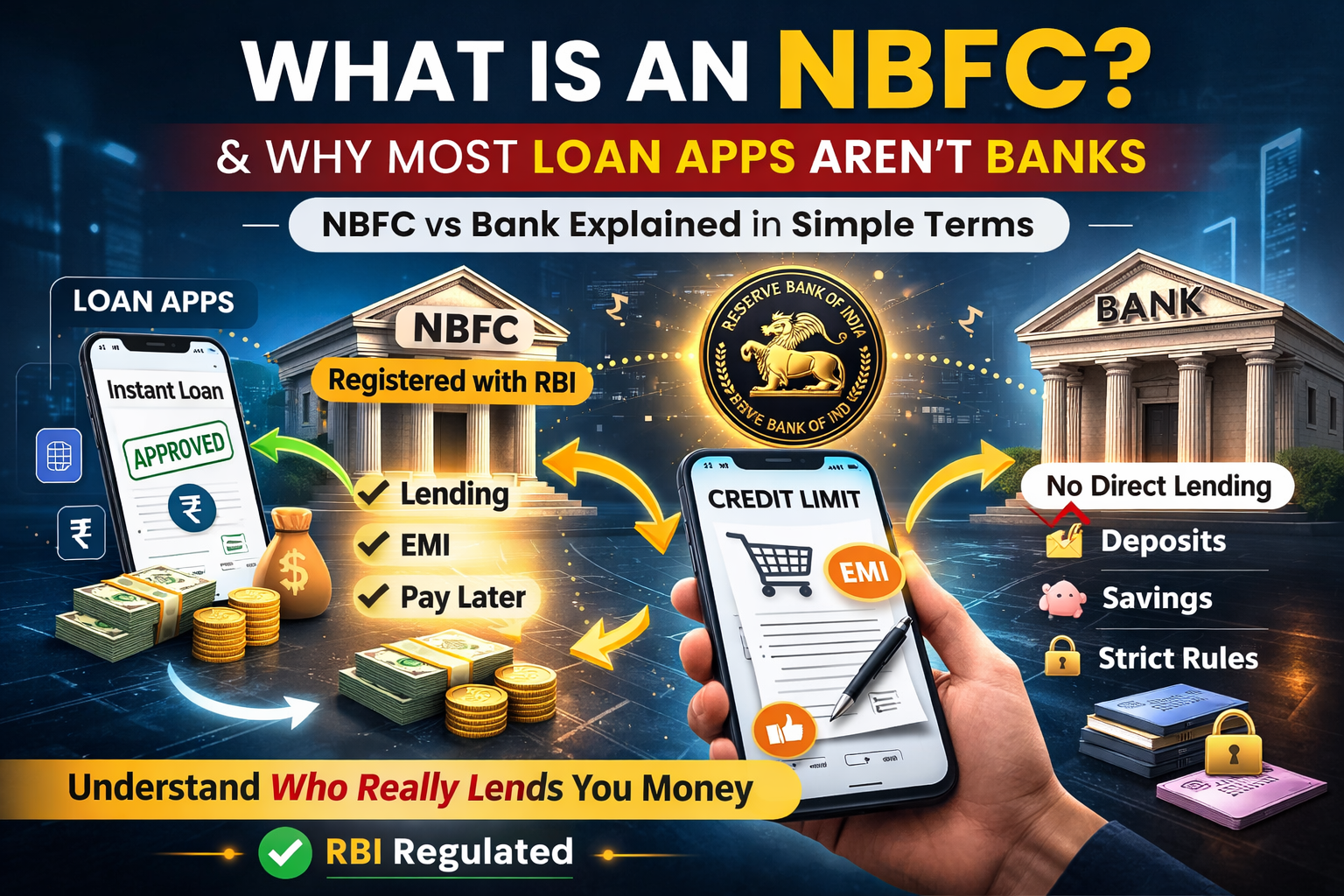
When most people take a loan through a mobile app, they assume one thing:
“A bank is giving me this money.”
The app looks professional. The process is quick. Funds arrive in your bank account. The repayment schedule resembles a traditional loan.
So it must be a bank, right?
Not necessarily.
In India, most instant loan apps are not banks. They operate through something called an NBFC — and understanding this structure is important if you want to borrow responsibly in today’s digital lending environment.
Let’s break this down clearly.
NBFC Full Form and Basic Meaning
NBFC stands for Non-Banking Financial Company.
An NBFC is a financial institution registered under the Companies Act that provides loans and other financial services, but it does not operate as a traditional bank.
NBFCs can:
- Offer personal loans
- Provide vehicle financing
- Offer business loans
- Operate digital lending partnerships
- Extend credit lines and EMI-based financing
However, they do not function exactly like banks — and that difference matters.
Who Regulates NBFCs in India?
NBFCs are regulated by the Reserve Bank of India (RBI).
However, regulation does not mean they operate under identical rules as banks.
Banks require a banking license and are subject to stricter deposit and capital norms.
NBFCs operate under a different regulatory framework designed for lending-focused institutions.
In recent years, RBI has also introduced specific digital lending norms to bring more transparency to fintech-NBFC partnerships. If you’ve read my explanation of RBI’s digital lending framework, you’ll know that many instant loan apps operate under this structure.
Understanding this regulatory background helps remove confusion about legality versus structure.
How NBFCs Are Different from Banks
The biggest confusion comes from assuming NBFCs and banks are interchangeable.
They are not.
1. Deposits
Banks can accept demand deposits such as savings and current accounts.
Most NBFCs cannot accept public deposits in the same way banks can. Their primary function is lending, not holding savings accounts.
2. Licensing
Banks require a formal banking license from RBI.
NBFCs require registration as a financial company but operate under a different category of financial authorization.
3. Business Model
Banks typically operate with diversified income streams — deposits, lending, treasury operations.
NBFCs generally focus heavily on lending activities.
This is why many NBFCs specialize in:
- Small-ticket loans
- Consumer finance
- EMI-based purchases
- Borrowers with limited credit history
4. Risk Profile
NBFCs often serve customer segments that traditional banks may consider higher risk — such as gig workers, freelancers, or individuals with thin credit files.
This specialization makes them central to the instant loan ecosystem.
Why Most Instant Loan Apps Are Not Banks
Here’s the key point many borrowers don’t realize:
The app you download is usually a technology platform — not the actual lender.
The loan is often disbursed by a partnered NBFC.
In simple terms:
The app:
- Provides the interface
- Collects KYC details
- Markets the credit product
- Manages user experience
The NBFC:
- Legally sanctions and disburses the loan
- Bears the credit risk
- Reports repayment behavior to credit bureaus
- Operates under RBI oversight
This is known as the digital lending partnership model.
Understanding this removes a lot of confusion about who is legally responsible for the loan.
How “Pay Later” and EMI Schemes Actually Work (A Real Example)
This structure doesn’t apply only to instant loan apps.
It also applies to many “Buy Now, Pay Later” (BNPL) and EMI schemes offered on major e-commerce platforms.
I remember being prompted to convert an Amazon purchase into three monthly installments. It felt convenient. I was approved for a credit limit that I could use within a month and either repay fully next month or convert into EMIs.
Initially, I assumed Amazon itself was lending me the money.
The registration process was short and smooth. But when I reviewed the terms carefully, I noticed something important:
The credit line was not coming directly from Amazon.
It was provided through one or more NBFC lending partners.
That’s when I realized something most users overlook:
Large platforms usually act as facilitators. The actual lending entity behind the scenes is often a registered NBFC.
This model typically works like this:
- The platform provides the interface.
- The NBFC provides the credit line.
- The NBFC carries financial risk.
- The NBFC reports repayment behavior to credit bureaus.
Because I had researched NBFC structures earlier, I knew one key thing:
The lending partner must be a registered NBFC under RBI.
With established brands, lending partnerships are usually disclosed clearly in agreements. But most users never check this detail — they assume the brand itself is the lender.
And that assumption can create misunderstanding.
Whether it’s a shopping EMI, a pay-later feature, or a short-term instant loan, the underlying structure often depends on an NBFC partnership model.
Are NBFCs Safe?
This question comes up frequently.
Registered NBFCs operating under RBI oversight are legal financial institutions.
However, safety depends on:
- Whether the NBFC is properly registered
- Whether the lending partner is clearly disclosed
- Whether terms and charges are transparent
- Whether data handling practices follow regulatory norms
Regulation creates accountability — but borrowers still need to verify information.
The key is clarity, not blind trust or unnecessary panic.
How to Check If a Loan App Is Linked to a Registered NBFC
If you’re using a loan app or pay-later feature, you can take simple steps to verify structure:
- Look for disclosure of the lending partner inside the app or agreement.
- Note the full legal name of the NBFC mentioned.
- Cross-check the entity on the official RBI website’s NBFC list.
- Review loan agreement documents carefully before acceptance.
If an app hides the lending partner or avoids naming the regulated entity, that is a warning sign.
I’ve explained how to verify a loan app’s legitimacy in a separate guide where we discuss common red flags to watch for.
Common Misunderstandings About NBFCs
Misconception 1: NBFCs are illegal.
Reality: Registered NBFCs are legal financial institutions regulated by RBI.
Misconception 2: All loan apps are scams.
Reality: Some operate through properly registered NBFC partnerships.
Misconception 3: NBFC loans don’t affect your CIBIL score.
Reality: Loans from registered NBFCs are usually reported to credit bureaus.
Misconception 4: If a brand is big, no verification is needed.
Reality: Even with well-known platforms, it’s wise to understand the lending structure.
Clarity reduces both overconfidence and unnecessary fear.
Final Thoughts: Understanding Structure Before Borrowing
Not every loan app is a bank.
Not every pay-later feature is funded by the brand you see on the screen.
In most cases, an NBFC sits behind the platform, legally disbursing the loan and managing regulatory responsibilities.
That doesn’t automatically make the system unsafe.
But it does mean borrowers should understand who is actually lending the money.
In a digital lending ecosystem where convenience is high and approval is fast, structural awareness becomes even more important.
Before applying for any instant loan or EMI scheme, ask one simple question:
“Who is the regulated lending entity behind this credit?”
The answer tells you more than the marketing ever will.
FAQ Section
❓ Is an NBFC the same as a bank?
No. An NBFC (Non-Banking Financial Company) provides loans and financial services but does not operate as a traditional bank. NBFCs cannot accept demand deposits like savings accounts in the same way banks can.
❓ Are NBFCs regulated by RBI?
Yes. Registered NBFCs in India are regulated by the Reserve Bank of India (RBI), but they operate under a different regulatory framework compared to banks.
❓ Do instant loan apps use NBFCs?
Most instant loan apps in India operate through partnerships with registered NBFCs. The app provides the interface, while the NBFC legally disburses the loan and manages compliance.
❓ Are NBFC loans reported to CIBIL?
Loans issued by registered NBFCs are usually reported to credit bureaus. Repayment behavior can affect your CIBIL score, just like bank loans.
❓ Is Buy Now Pay Later (BNPL) provided by NBFCs?
In many cases, yes. Large platforms offering EMI or pay-later options typically partner with registered NBFCs that provide the underlying credit line.