5 Dirty Tricks Loan Apps Use in India — And How to Outsmart Every One
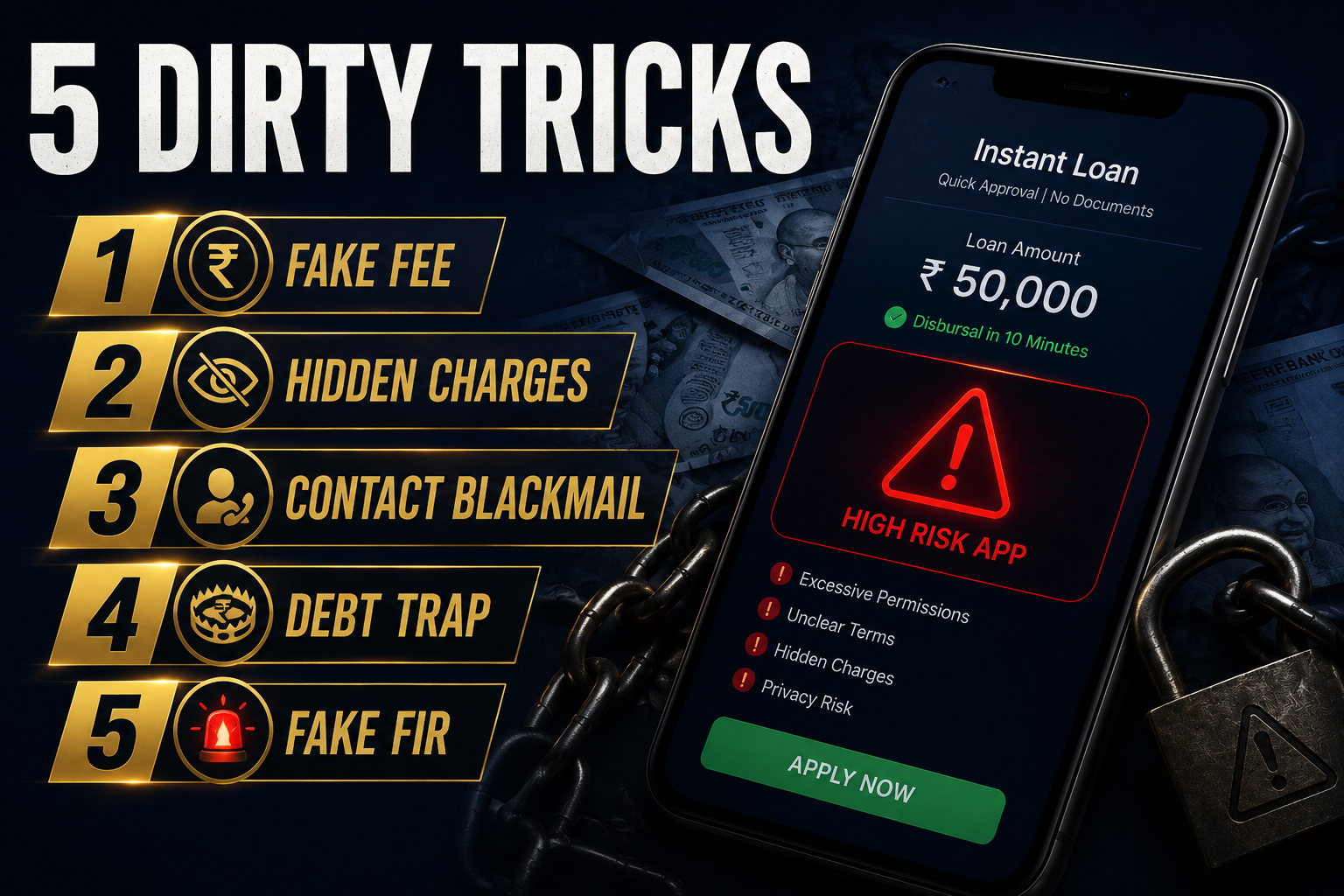
The five most common tactics are: fake approval followed by an upfront KYC fee, hidden charges deducted before disbursal, contact list blackmail during recovery, rolling loan traps that push you deeper into debt, and fake legal threats designed to frighten you into paying. All five are either illegal under RBI guidelines or exploitative in ways most borrowers don't recognise until it's too late. Knowing them in advance is the only real protection.
- Trick 1: Fake Approval + Upfront Fee
- Trick 2: Hidden Charges After Disbursal
- Trick 3: Contact List Blackmail During Recovery
- Trick 4: The Rolling Loan Trap
- Trick 5: Fake Legal Threats
- All 5 Tricks — Quick Reference Table
- How to Protect Yourself Before You Apply
- GetLoanCredit Verdict
- Frequently Asked Questions
Trick 1: Fake Approval Followed by an Upfront Fee
You receive a notification or SMS saying your loan is approved — sometimes for an amount you never applied for. When you follow up, you're told there's a "KYC mismatch," "account verification fee," or "insurance charge" that must be paid before the funds are released. The message creates urgency: pay now or lose the offer.
There is no loan. This is a fee collection scam. The moment you pay, the "loan" disappears and contact becomes impossible. These messages are often sent via bulk SMS to thousands of numbers simultaneously — most recipients never applied for anything.
No legitimate RBI-registered lender charges any fee before disbursing the loan. Processing fees, GST, and insurance are deducted from the disbursed amount — never paid upfront by the borrower. If any app or message asks for money before you receive the loan, it is a scam. Do not pay. Do not engage. Report it immediately at cybercrime.gov.in or call 1930.
Trick 2: Hidden Charges That Appear After Disbursal
You apply for ₹10,000. Only ₹8,800 hits your account. Processing fees, platform charges, GST, and insurance were deducted silently before disbursal — but you still repay the full ₹10,000 plus interest. The charges were technically disclosed, buried in terms you scrolled past at 1am in a financial emergency.
Before accepting any loan offer, look for the disbursement amount on the offer screen — not the loan amount. RBI guidelines require a Key Fact Statement showing the exact amount you will receive and the exact total you will repay. If the app doesn't show these figures clearly before you accept, don't proceed. For the full breakdown of every hidden charge and what they actually cost, read: Why Your ₹10,000 Loan Might Cost You ₹15,000.
Trick 3: Contact List Blackmail During Recovery
During onboarding, the app requests access to your contacts, gallery, and sometimes call logs. You grant these permissions without reading carefully because you need the money urgently. When you miss a payment — even by hours — recovery agents use your contacts to send messages to your friends, family, and colleagues implying you are a fraudster or defaulter.
Twenty-five calls in one day. Messages to people I hadn't spoken to in years, claiming I was a "loan defaulter" and asking them to "advise me to pay immediately." The shame was designed to be worse than the debt itself — and it worked until I understood it was a calculated tactic, not a legitimate recovery method.
Before installing any loan app, check what permissions it requests on the Play Store listing. Deny contacts, gallery, microphone, and call log access — a legitimate RBI-registered app does not need these to disburse or recover a loan. If the app refuses to function without contact access, uninstall it. Use only verified apps like KreditBee, Fibe, or Nira that operate without requiring contact list permissions. For your full legal rights if this is already happening, read: Loan App Threatening to Contact Your Friends? Do This Now.

Trick 4: The Rolling Loan Trap
You can't repay Loan A on time. The app — or a different app — offers you Loan B to cover it. You take it. Now you have two loans, two sets of fees, two deadlines. When Loan B comes due, the same offer appears. Within 3 months, what started as a ₹5,000 emergency has become ₹20,000+ in stacked debt across multiple apps, all with overlapping repayment dates and compounding penalties.
This is not an accident. Some apps are specifically designed to keep borrowers in this cycle because repeat borrowers with overlapping loans generate far more fee revenue than single clean transactions. The offers arrive precisely when you are most financially vulnerable.
Never take a new loan to repay an existing one. Instead, contact the original lender's official customer support and ask for a repayment extension or revised schedule. Most RBI-registered NBFCs have a formal process for this. A 2-week extension costs far less than the fees on a second loan. If you genuinely cannot repay, ask for a settlement offer — a "settled" CIBIL status is damaging but far better than a debt spiral across multiple apps.
Trick 5: Fake Legal Threats by Call or Message
Recovery agents call claiming to be lawyers, police officers, or court officials. You receive WhatsApp messages with fake legal notices, FIR numbers, and warnings that you will be arrested within 24 hours if you don't pay immediately. The language is aggressive, official-sounding, and deliberately terrifying — designed to make you pay without thinking.
Loan default is a civil matter in India, not a criminal offence. You cannot be arrested for missing an EMI. FIR threats from recovery agents are almost always fake and constitute an offence themselves under the Information Technology Act. Real legal action for loan default goes through civil courts over months — not WhatsApp messages within 24 hours.
Do not panic. Screenshot everything — every message, every call log entry, every WhatsApp communication. Then report the specific threats at cybercrime.gov.in or by calling 1930. File a complaint at the RBI Sachet portal at sachet.rbi.org.in naming the app and lender. These complaints have resulted in app delisting and regulatory action in multiple documented cases since 2021.
All 5 Tricks — Quick Reference
| # | The Trick | What It Looks Like | How to Beat It |
|---|---|---|---|
| 1 | Fake approval + upfront fee | "Pay ₹499 KYC fee to release funds" | Never pay before disbursal — it's a scam, full stop |
| 2 | Hidden charges post-disbursal | Apply ₹10,000 — receive ₹8,800 | Check disbursement amount on offer screen before accepting |
| 3 | Contact list blackmail | Friends and family messaged after missed EMI | Deny contact permissions at install — use RBI-registered apps only |
| 4 | Rolling loan trap | Offered Loan B to repay Loan A | Call lender for extension — never stack loans across apps |
| 5 | Fake legal threats | "FIR filed — pay now or be arrested" | Screenshot everything, report at cybercrime.gov.in + RBI Sachet |
How to Protect Yourself Before You Even Apply
Every trick above has one thing in common: it is far easier to prevent than to fix after the fact. Ten minutes of verification before you apply is the single most effective protection available to any borrower in India.

- Verify the NBFC lending partner — find the name in the app's Terms and confirm it appears on the RBI NBFC list at rbi.org.in
- Check permissions before installing — deny anything beyond camera and storage on the Play Store listing
- Read the Key Fact Statement — total disbursement and total repayment amount must be shown clearly before you accept
- Never pay any fee before receiving the loan — legitimate lenders deduct from disbursed amount, never charge upfront
- Use only verified apps — KreditBee, Fibe, Nira, and mPokket pass all five checks and operate within RBI guidelines
For the complete verification process step by step, read: How to Know If a Loan App Is Trustworthy in India. For what to do if a loan app is already threatening to contact your contacts, read: Are Instant Loan Apps Safe in India? My Real Experience.
⭐ GetLoanCredit Verdict
The dirty tricks loan apps use in India are predictable once you've seen them — and entirely avoidable with 10 minutes of verification before you apply. Stick to RBI-registered apps, deny unnecessary permissions, never pay before disbursal, and document everything if recovery behaviour turns aggressive. If you need to urgently borrow money right now using a safe app, read: I Needed ₹10,000 Urgently — Here's Exactly What I Did.